



Amendments to the State Labour Inspectorate Act have been passed – it is worth preparing for new challenges
On 12 March 2026, the Senate adopted the amendment to the State Labour Inspection Act (PIP) without amendments. The reform significantly expands the powers of labour inspectors, granting them, among other things, the authority to convert civil law contracts, including B2B contracts, into employment contracts by means of an administrative decision.
The Act will now be sent to the President for signature.
Below, we outline the key issues arising from the adopted amendment and the most significant challenges for companies using flexible forms of cooperation.
Conversion of a civil law contract into an employment contract – procedure
The most significant element of the amendment to the Act on the National Labour Inspectorate is the granting of powers to the labour inspector to convert a civil law contract into an employment contract by way of an administrative decision.
However, such a decision cannot be issued immediately, as illustrated in the diagram below:
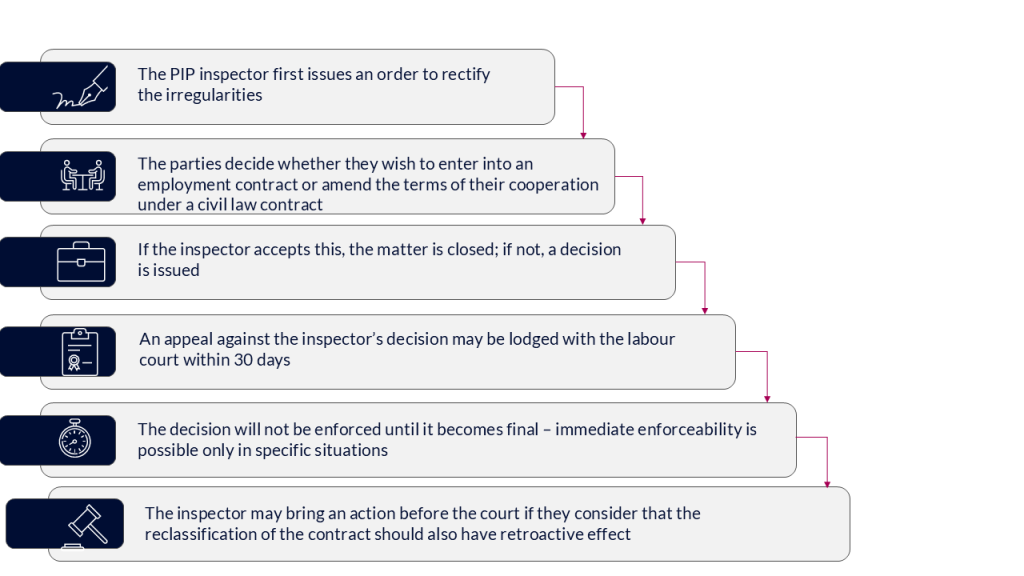
Immediate enforceability of the decision
A decision by the National Labour Inspectorate (PIP) to convert a civil law contract into an employment contract takes legal effect, including in relation to public law liabilities, from the date of its issuance. However, it will not be immediately enforceable – it will only become enforceable after the deadline for lodging an appeal has expired or on the date of a final court ruling.
The rule of immediate enforceability will, however, apply to persons enjoying special protection against dismissal (e.g. pregnant women, persons approaching retirement age).
The will of the parties – will it matter?
The adopted amendment provides that the labour inspector should take into account the parties’ intention, provided that it is not contrary to the law (in particular labour law provisions), the principles of social coexistence, or intended to circumvent the law. This means that the parties will be able to adapt the content or manner of performance of a civil law contract in such a way as to eliminate the characteristics typical of an employment relationship.
At the same time, the course of legislative proceedings in the Sejm may indicate that, in practice, the role of the parties’ intentions may be limited. If the inspector considers that, in reality, the cooperation is predominantly of an employment relationship nature, the parties’ intentions are unlikely to be decisive when issuing a decision on the conversion of the contract.
Voluntary conversion of a contract – a trap or an opportunity?
The amendment introduces a mechanism for the ‘voluntary’ conversion of civil law contracts into employment contracts within 12 months of the Act coming into force. The mechanism is designed to enable businesses to avoid criminal sanctions and heavy fines.
However, such a step should be very carefully considered and discussed with experts, because:
- a voluntary change to a contract may be regarded as an admission of past legal violations,
- it does not provide protection against claims for the establishment of an employment relationship for past periods,
- This could lead to an audit by the Social Insurance Institution (ZUS) and the tax authorities.
What next? Recommended actions.
The new regulations provide for a broader exchange of data between ZUS, PIP and KAS, the possibility of remote inspections, and increased penalties for breaches of employee rights. Consequently, it is advisable to review existing cooperation models as soon as possible.
Recommended actions include:
- Audit of B2B contracts and standard contract templates – identifying the characteristics of an employment relationship and preparing amendments to mitigate the risk of reclassification.
- Analysis of the actual nature of the cooperation and documentation – comparing practice with contractual provisions and assessing available evidence of service provision.
- Recommendations for changes and internal procedures – drafting policies and procedures in preparation for an inspection.
- Preparation for a PIP inspection – team training, development of procedures and support in preparing a defence file.
- Optional – submitting requests for interpretation of regulations and calculating the financial risks associated with the potential reclassification of contracts.
Please feel free to contact our experts, who will help prepare your organisation for the PIP’s new powers, minimising legal and tax consequences:
| Anna Misiak | anna.misiak@mddp.pl | +48 500 046 024 |
| Rafał Sidorowicz | +48 506 788 582 | |
| Agnieszka Telakowska-Harasiewicz | agnieszka.telakowska-harasiewicz@mddp.pl | +48 503 971 849 |
or your MDDP advisor.
This Tax Alert does not provide legal or tax advice. MDDP Michalik Dłuska Dziedzic & Partners spółka doradztwa podatkowego spółka akcyjna is not responsible for the use of the information provided in the Alert without the prior consultation with legal or tax advisers.