



New PIT progression and higher CIT. How could taxpayers’ burdens change?
- Corporate tax, INSIGHT, Personal Taxes, Trochę o CIT
- 5 minuty
The PIT and CIT changes announced by the government could significantly affect the amount of tax paid by employees and entrepreneurs. The new PIT brackets are intended to mitigate the effects of rising salaries and the growing number of individuals subject to the 32% tax rate. At the same time, the planned CIT increase, a higher solidarity levy and restricted access to lump-sum taxation would mean higher burdens for some taxpayers. Although these are currently only the initial assumptions of the tax reform, it is already possible to identify the groups that may benefit the most and those that may have to pay more.
PIT changes in 2027. How would the new tax brackets work?
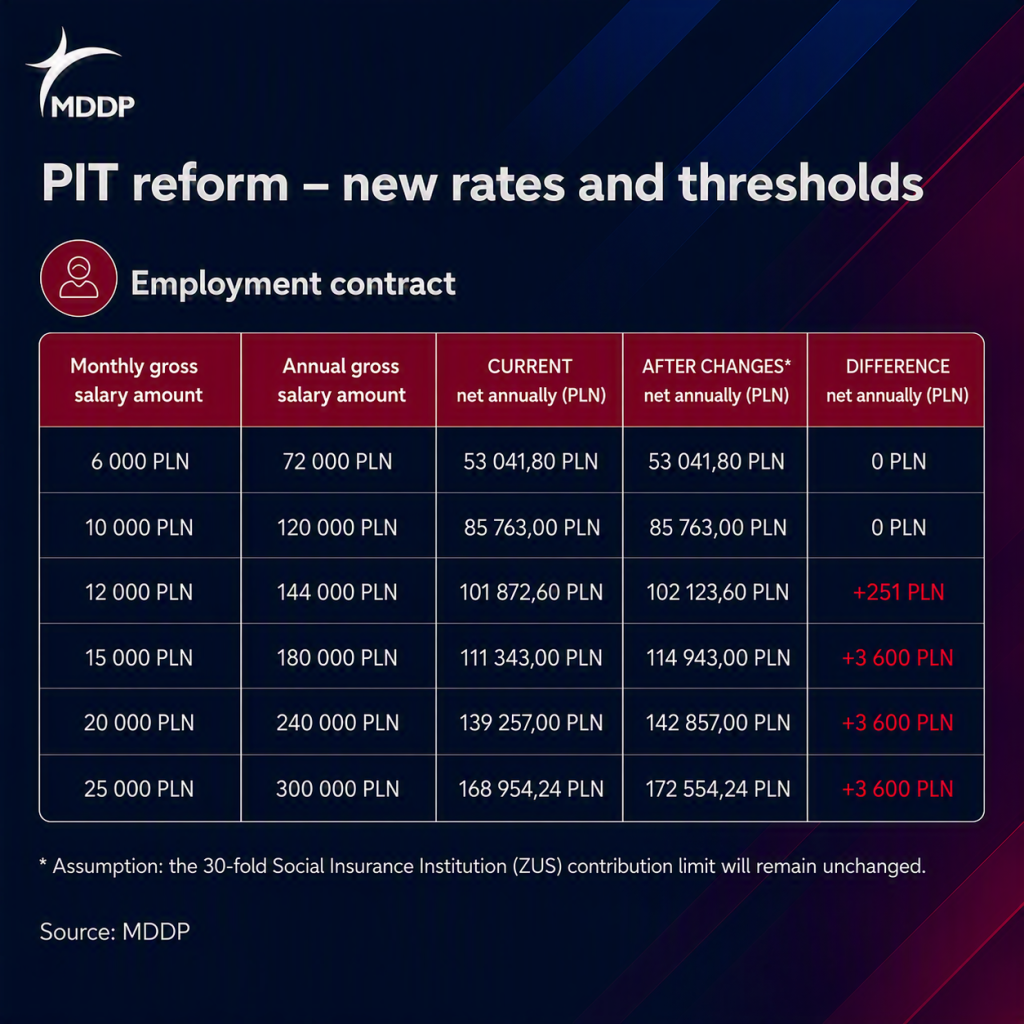
One of the key elements of the tax reform is a change to PIT progression. According to the announcements, an additional 24% tax rate would be introduced for annual income between PLN 130,000 and PLN 150,000, while the 32% rate would apply only to income exceeding PLN 150,000.
The change is intended to mitigate the effects of so-called tax bracket creep. In recent years, salary growth has caused an increasing number of taxpayers to exceed the annual income threshold of PLN 120,000 and become subject to the higher PIT rate. As a result, the higher rate has also applied to individuals who can hardly be regarded as the highest-earning taxpayers.
Who would benefit from the PIT changes?
The greatest benefits may be available to taxpayers whose income exceeds the current annual threshold of PLN 120,000 and who settle PIT according to the progressive tax scale. This includes employees, management board members, contractors, pensioners and entrepreneurs taxed according to the progressive scale.
The estimated benefits would already become noticeable at a gross monthly salary of approximately PLN 12,000. The value of the tax savings would also increase in line with income. The maximum benefit resulting from the new tax brackets could amount to approximately PLN 3,600 per year for an individual taxpayer and up to PLN 7,200 per year for spouses filing jointly.
At the same time, the reform does not provide for an increase in the tax-free allowance. This means that individuals earning up to PLN 120,000 per year would most likely not experience any direct effects of the changes.
Solidarity levy to increase to 5%
At the same time, the government has announced an increase in the solidarity levy from 4% to 5%. For individuals earning the highest incomes, this would result in a higher effective tax burden.
The significance of this change is broader than it might appear. The solidarity levy applies not only to income taxed according to the progressive PIT scale, but also to certain capital income and income from controlled foreign companies (CFCs). In practice, some of the highest-earning taxpayers may face higher burdens despite the more favourable PIT brackets.
Lump-sum taxation for entrepreneurs in doubt
One of the most significant changes for entrepreneurs may be the restriction of access to lump-sum taxation on registered revenue.
The revenue threshold for eligibility to apply the lump-sum taxation regime is to be reduced from EUR 2 million to EUR 250,000. At the same time, taxpayers who remain under the regime will be subject to a 17% tax rate on annual revenue exceeding EUR 300,000.
The new rules are expected to take effect on 1 January 2027. However, there is an important caveat.
Revenue earned in 2026 may already affect a taxpayer’s ability to continue applying the lump-sum taxation regime in 2027.
For example, if an entrepreneur’s revenue exceeds EUR 250,000 in 2026, they will no longer be eligible to opt for the lump-sum regime in 2027.
If their revenue remains below that threshold in 2026 but exceeds EUR 300,000 in 2027, the excess amount will be taxed at the 17% rate. In addition, they will not be able to continue applying the lump-sum taxation regime in 2028.
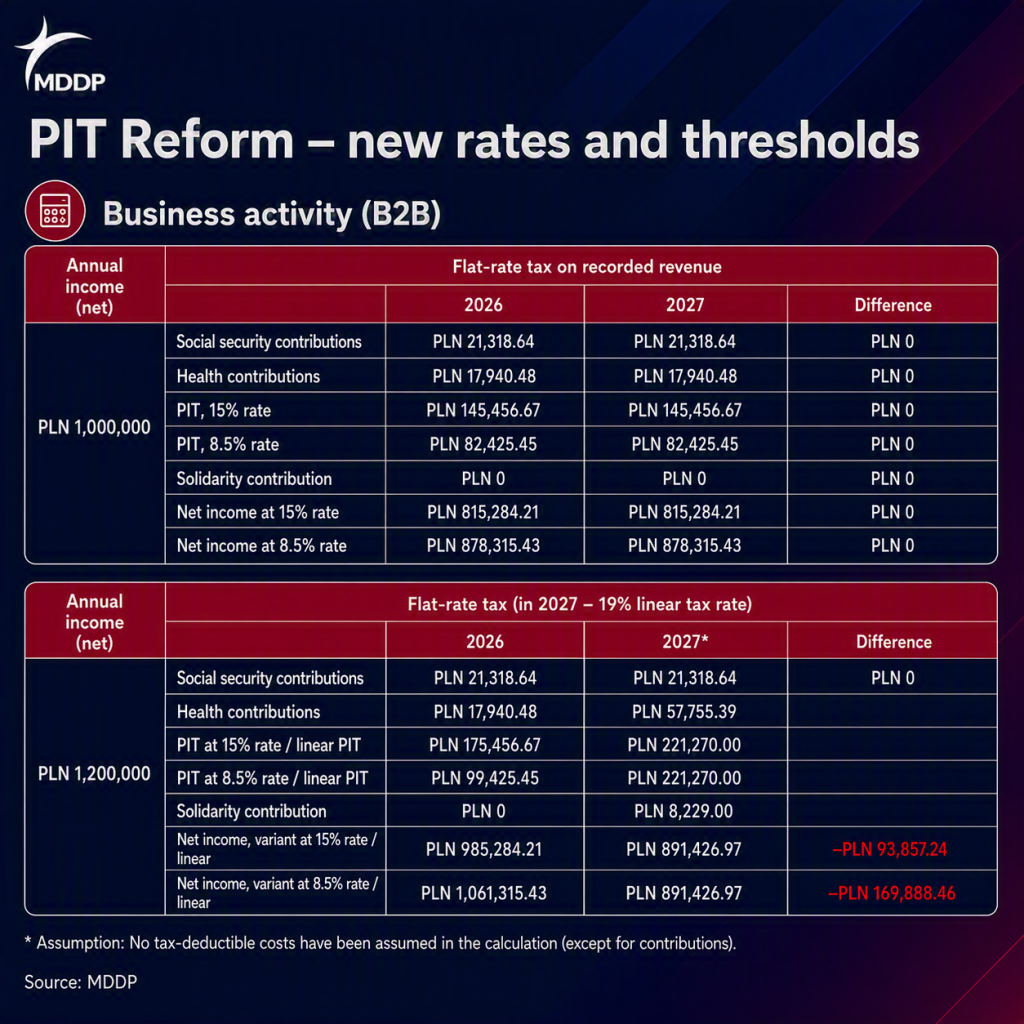
The change may particularly affect individuals operating highly profitable businesses with relatively low costs, such as IT specialists, consultants, doctors and members of other specialist professions. For them, losing the right to lump-sum taxation could result in higher PIT, an increased health insurance contribution and the application of the solidarity levy to part of their income.
For some entrepreneurs, the new rules could lead to an increase in their overall fiscal burden measured not in thousands, but in tens or even hundreds of thousands of zlotys per year.
CIT increase. What would it mean for companies and investors?
The cost of the reform is expected to be partially financed by increasing the standard CIT rate from 19% to 22%.
For the largest companies, this would mean higher tax burdens and reduced profitability for certain investments. At the same time, a higher CIT rate could make Poland less attractive compared with other Central and Eastern European countries, which have long competed for foreign investment by offering relatively low levels of corporate taxation.
The discussion concerning the CIT increase therefore involves not only budget revenue, but also the competitiveness of the Polish economy and future inflows of foreign capital.
Tax reform would change the burdens faced by different groups of taxpayers
The planned PIT and CIT changes would not amount to a general tax reduction. Instead, the reform should be viewed as a redistribution of burdens among different groups of taxpayers. Individuals taxed according to the progressive tax scale whose income exceeds the current second tax bracket may benefit. At the same time, entrepreneurs using lump-sum taxation, individuals subject to the solidarity levy and the largest companies paying CIT may face higher liabilities.
However, a final assessment of the reform will only be possible after the draft legislation has been published. The details of the new regulations will show how the tax burdens of individual groups of taxpayers would change in practice.

Partner | Tax adviser
Tel.: +48 506 788 582

Partner | Tax adviser
Tel.: +48 790 732 266